


Royal Match
Dream Games, Ltd.
I spent time with Royal Match as a casual puzzle game, and my overall impression is easy to explain: it is best when you want a polished, short-session match-three experience with a light castle-building layer attached. The central idea is simple—solve color-matching boards to help restore King Robert’s castle—but the appeal comes from how steadily each puzzle feeds the next small decorating decision.
That simplicity also makes the game easy to misunderstand. It is not a deep castle simulator, and it is not a puzzle collection built around radically different rules. It is a focused mobile game designed for repeatable levels, occasional difficulty spikes, and a gradual sense of progress. If that loop sounds satisfying, I can see it becoming a dependable break-time game. If you want complex strategy, uninterrupted free play, or a fully decoration-focused experience, I would look elsewhere.
What I considered before recommending it
My first decision criterion was the puzzle board itself. A decoration reward cannot rescue a matching game that feels dull, so I paid attention to whether the levels offered enough short-term decisions to keep me engaged. Royal Match works best when I treat each move as a small planning problem rather than simply tapping the first available match. Looking for combinations, preserving useful pieces, and thinking about the next cascade gives the boards more character than the basic premise suggests.
Related News

Why DOP 4: Draw One Part is Captivating Puzzle Fans Everywhere
Why Tile Explorer - Triple Match Is the Puzzle Game of the Moment
The second criterion was how naturally the castle progression supports the puzzles. Here, the two parts are closely connected: completing a level gives me the means to make another change around the castle. That relationship gives ordinary puzzle wins a visible purpose. I am not just clearing a board for an abstract score; I am working toward the next improvement in the royal setting.
I also considered how well the game respects different session lengths. This is the kind of title I can open while waiting for an appointment, play through a few boards, and close without needing to remember a complicated storyline. At the same time, the steady progression can encourage one-more-level behavior, especially when a stage is close to completion. Anyone trying to keep mobile gaming strictly limited should be aware of that rhythm.
Related News

Why WhatsApp Messenger Still Makes Everyday Communication Feel Easy

Jurassic World: The Game Is the Better Dino Tycoon for Strategic Players

Threads in Real Life: Who Should Join, Lurk, or Leave

How SHEIN Turned Shopping Into an Endless Content Feed

How to Make Fortnite Feel Smarter on Mobile

Should You Switch to Microsoft Outlook on Mobile?
Royal Match is free to download and play, with optional purchases ranging from $0.99 to $99.99 per item. That matters to my recommendation because the free entry point is generous enough to test the core loop, but the presence of purchases means I would not treat it as a completely frictionless game. I prefer to decide in advance whether I am willing to wait, replay, or spend when progress becomes less comfortable.
The game is suitable for Everyone, which matches its bright, non-threatening presentation. It was released on February 25, 2021, and Dream Games, Ltd. continues to identify it through its current version, 34388. On Android, the listed minimum is version 7.0 of the operating system, so compatibility is broad, although the actual experience will still depend on the phone’s age and performance.
The puzzle loop is strongest in short, focused sessions
What I like most is the clarity of the main loop. I enter a level, study the arrangement, make matches, and use the result to move the castle forward. There is very little setup between decisions. That makes it a good companion for a commute, a coffee break, or the few minutes before bed when I want something more active than scrolling but less demanding than a large adventure game.
Gallery
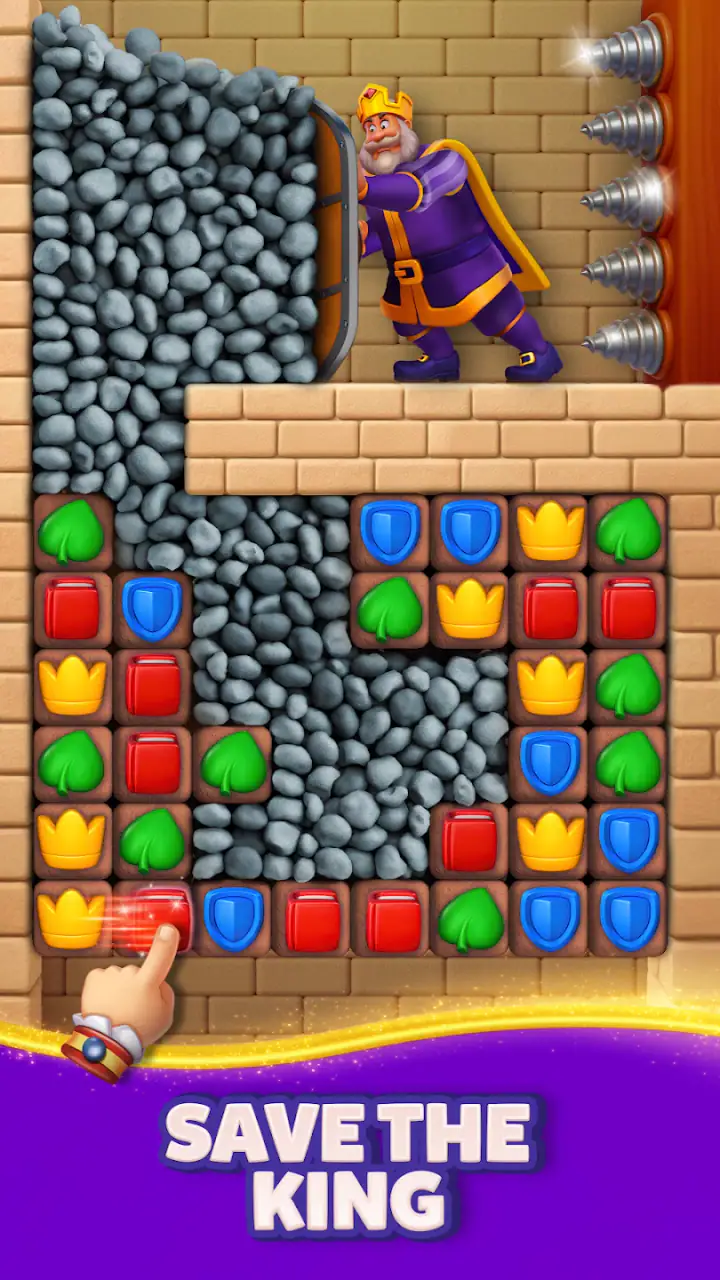
The best way I found to approach a board was to resist immediate matches when they were not useful. A move that clears a small group may look attractive, but waiting for a better alignment can create a larger chain or open a blocked area. This is one of the game’s less obvious strengths: it rewards a little patience without requiring a long tutorial or a complicated rulebook.
I also learned to separate “progress now” from “progress efficiently.” Sometimes the obvious move advances the board safely, while a more ambitious setup could produce a stronger result but risks leaving awkward pieces behind. That trade-off makes the levels feel more deliberate than a purely reflex-based matching game. I would not call the puzzles deeply strategic, but they offer enough room for judgment to keep the routine from becoming completely automatic.
Another useful habit is to inspect the whole board before touching anything. In a fast session, I can easily focus on one corner and miss a better possibility elsewhere. Taking a few seconds to scan for potential combinations, difficult areas, and moves that may trigger a chain helps me avoid wasting turns. This is especially valuable when the level objective depends on clearing a particular section rather than simply making any match.
Castle decoration gives each win a visible purpose
The castle layer is not separate from the puzzle experience; it is the reason the repeated boards feel connected. After a successful level, I get to push the royal setting forward through decoration and restoration choices. I enjoy this because the visual result accumulates gradually. A single change may be small, but several completed tasks make the environment feel more personal and more complete.
For me, the decorating element works best as a reward system rather than a standalone design tool. I would not open Royal Match expecting the detailed freedom of a dedicated interior-design game. The appeal is choosing or approving the next improvement after earning it through play. That distinction is important when deciding between this and a game whose main purpose is unrestricted customization.
A practical tip is to treat the castle tasks as a pacing guide. When I feel myself playing levels without much attention, the next restoration objective gives me a reason to pause and decide whether I am still enjoying the process. It also helps break the session into manageable goals: solve a few puzzles, make a visible change, then stop instead of continuing indefinitely.
Where the game wins against familiar puzzle alternatives
Compared with a bare match-three game, Royal Match offers a stronger sense of continuity. A standalone puzzle title may be better if I want nothing except boards and scores, but this game gives each win a place in a broader progression. The castle makes the activity feel less disposable, particularly for players who enjoy collecting improvements and watching a setting change over time.
Compared with a story-heavy mobile adventure, it is much easier to pick up and put down. I do not need to remember a large cast or follow a complicated plot to understand what I am doing. The royal theme supplies atmosphere without becoming a barrier to entry. That makes the game more approachable for someone who wants a casual puzzle first and a narrative second.
It also has an advantage over many purely decorative games for players who need an active task. The castle is not improved by passive browsing; I have to solve boards to earn the next step. That creates a useful balance between mental activity and visual reward. I can play when I want a small challenge, then enjoy the result afterward.
The game’s broad reach supports that accessibility. It has an average rating of 4.6 from around 10 million ratings, and it has passed 100 million installs. Those figures do not guarantee that every player will enjoy the same pacing, but they do show that the format has connected with a very large audience. I would interpret that as evidence of an approachable design, not as proof that it is the best choice for every puzzle fan.
Where another type of game may suit you better
I would skip Royal Match if my priority were serious puzzle depth. Players who prefer logic puzzles, word challenges, spatial problems, or carefully designed one-off brainteasers may find the repeated matching structure too familiar. The game asks me to optimize moves within a recognizable format, but it does not replace a dedicated logic game with more varied intellectual demands.
I would also choose another option if I wanted a calm, completely predictable experience. Puzzle difficulty can change the mood of a session. When a level resists several attempts, the castle goal that normally motivates me can start to feel like pressure. For some players, replaying a board is part of the fun; for others, it turns a relaxing break into a frustrating interruption.
The purchase system is another reason to consider alternatives. Because optional items can cost from $0.99 up to $99.99, I would recommend using the game with a clear personal spending limit. Someone looking for a one-time purchase with no recurring temptation may be happier with a paid puzzle game. Someone comfortable with free-to-start games can simply test the early experience and decide whether the later rhythm feels fair to them.
I would not choose it as a substitute for a full creative decorating app either. The castle progression gives the puzzles meaning, but the decorating choices are part of a guided game loop rather than an open-ended design workspace. If the main pleasure comes from arranging rooms freely, experimenting with styles, or building without puzzle requirements, a dedicated design alternative is likely a better fit.
What changes when you move from another puzzle game
The cost of switching is low if you are coming from another match-three title. You already understand the basic idea of matching pieces, and the castle objectives make the purpose of each session clear quickly. The main adjustment is learning not to judge every board by immediate progress. Some stages reward looking ahead and creating better opportunities instead of clearing the easiest available group.
The transition is less direct if you are leaving a minimalist puzzle game. Royal Match adds a progression layer, so there is more to track than the board in front of me. That extra structure is helpful when I want motivation, but it can feel like unnecessary decoration when I only want a clean mental exercise. Before switching, I would ask whether I want rewards and restoration to shape my play or stay out of the way.
Players moving from a decoration game should expect the opposite trade-off. The castle is a destination for puzzle progress, not a blank canvas. I would begin with the puzzle rules, not with the assumption that every design decision is freely available. That expectation makes a big difference to whether the game feels satisfying or restrictive.
My most useful switching advice is to play without spending during the initial trial period. This lets me judge the board design, the pace of castle improvements, and my reaction to difficult stages before money becomes part of the routine. If I still enjoy the basic loop when a level takes longer than expected, the game is probably a good match for me. If my enjoyment depends on removing every delay, I would treat that as a sign to choose a different type of puzzle experience.
Everyday scenarios where it fits
Imagine I have ten minutes before a train arrives. Royal Match fits that moment because I can start a level immediately, make a few decisions, and stop after a natural piece of progress. I do not need to prepare a long session or remember a complicated objective. The castle gives me a small sense of accomplishment even when the available time is limited.
It can also work during a quiet evening when I want a gentle routine. I might play until I complete a castle task, then close the game rather than chase an arbitrary score. That approach keeps the decorating layer useful: it acts as a stopping point instead of encouraging endless board clearing.
On the other hand, I would avoid opening it when I am already impatient. A difficult level, a failed attempt, or the desire to continue toward the next reward can make a short break longer than planned. In that mood, a game with fixed-length puzzles or no progression pressure would be a better choice.
Practical expectations about access and spending
The game is free, so I can evaluate the central experience without committing to a purchase. Optional in-app items are available, and the broad price range means spending can remain small or become substantial depending on the choices I make. I would keep purchases disabled or protected if the phone is shared with children, even though the content rating is Everyone.
I also recommend checking the device before installing. Android support begins at version 7.0, which covers many phones, but compatibility on paper is not the same as a smooth experience on every older device. If storage, battery life, or general performance are already concerns, I would be cautious about adding another regularly played game.
The large install base and strong average rating make Royal Match easy to find, but popularity should not replace personal testing. The important questions are more specific: Do I enjoy planning matches? Do I like earning decorative progress? Am I comfortable with a free game that offers optional purchases? Can I stop after a short session? My answers matter more than the headline numbers.
My recommendation depends on the player
I recommend Royal Match to players who want a friendly, accessible puzzle game with a visible restoration goal. It is particularly suitable for people who like match-three boards but need more motivation than a score counter provides. The castle gives the routine a sense of direction, while the straightforward controls make it easy to share with someone who does not usually play mobile games.
I recommend it with reservations for anyone sensitive to difficulty spikes or purchase prompts. The free starting point is useful, but I would approach the game as an ongoing service-style experience rather than a single finished puzzle package. Set a spending boundary, decide how much time you want to give it, and treat retries as optional rather than necessary.
I would skip it if I want advanced logic, unrestricted decoration, or a one-time premium experience. Those preferences point toward different categories, and no amount of castle polish changes the fact that Royal Match is built around repeated matching levels. Its strengths are focus and accessibility, not variety across many puzzle genres.
After weighing those trade-offs, my final view is positive. Dream Games, Ltd. has made a game that understands why short puzzle sessions work: the rules are approachable, the goals are visible, and each win contributes to a setting I can watch improve. The best way to enjoy it is to play for the satisfying decisions, not to rush the next reward. With that mindset, it is an easy game to recommend to casual puzzle fans; without it, a less progression-driven alternative may be the wiser choice.
FAQs for Royal Match
What is Royal Match and what can I expect from the gameplay?
Royal Match is a vibrant and engaging puzzle game where players aim to solve match-3 puzzles while assisting King Robert to restore his castle. Expect colorful graphics, diverse levels, and various power-ups to keep the gameplay exciting. The game combines strategic thinking with fun elements, making it suitable for all ages.
Is Royal Match free to play, or does it include in-app purchases?
Royal Match is free to download and play. However, it does include in-app purchases for those who wish to enhance their gaming experience. These purchases can range from additional lives to special power-ups and boosters. Players can enjoy the game without spending money, though progress may be slower.
How challenging is Royal Match, and is it suitable for all skill levels?
Royal Match is designed to cater to players of all skill levels. The initial levels provide a gentle introduction to the game mechanics, while later stages increase in difficulty, requiring more strategic thinking. With its progressive challenge, both casual gamers and puzzle enthusiasts will find the game enjoyable.
Does Royal Match require an internet connection to play?
Royal Match can be played offline, allowing players to enjoy the game without an internet connection. However, certain features, such as purchasing in-game items or participating in events, may require connectivity. Offline play makes it convenient to enjoy the game anytime and anywhere.
Are there any ads in Royal Match that might interrupt gameplay?
While Royal Match is primarily ad-free during gameplay, players might encounter optional ads that offer rewards, such as extra lives or boosters. These ads are non-intrusive and can be skipped if not needed. The game maintains a smooth and uninterrupted experience for the players.
Pros
- Engaging and colorful levels.
- No intrusive ads during gameplay.
- Regular events and challenges.
- Smooth and responsive controls.
- Offline play available.
Cons
- In-app purchases can be pricey.
- Some levels feel repetitive.
- Limited lives can halt progress.
- Energy system can be restrictive.
- Notifications can be overwhelming.


